

LED mesh screens can transform façades, glass curtain walls, stages, and commercial spaces into large digital media surfaces. Yet a successful installation requires more than choosing screen size and pixel pitch. Buyers must estimate maximum load, average consumption, power-supply capacity, cable current, and annual electricity cost. The method below provides a practical starting point for LED mesh screen project planning.
What Information Is Needed Before Calculating Power Consumption?
A useful estimate must be based on the exact screen configuration. Pixel density, operating voltage, LED color, brightness, content, and operating time can all affect the final result.
Screen Area and Product Rating
Begin by calculating the active display area:
Screen area = width × height
For irregular façades, divide the screen into measurable sections, calculate each section separately, and add their areas. Then confirm the maximum power rating for the selected LED mesh screen model and pixel pitch.
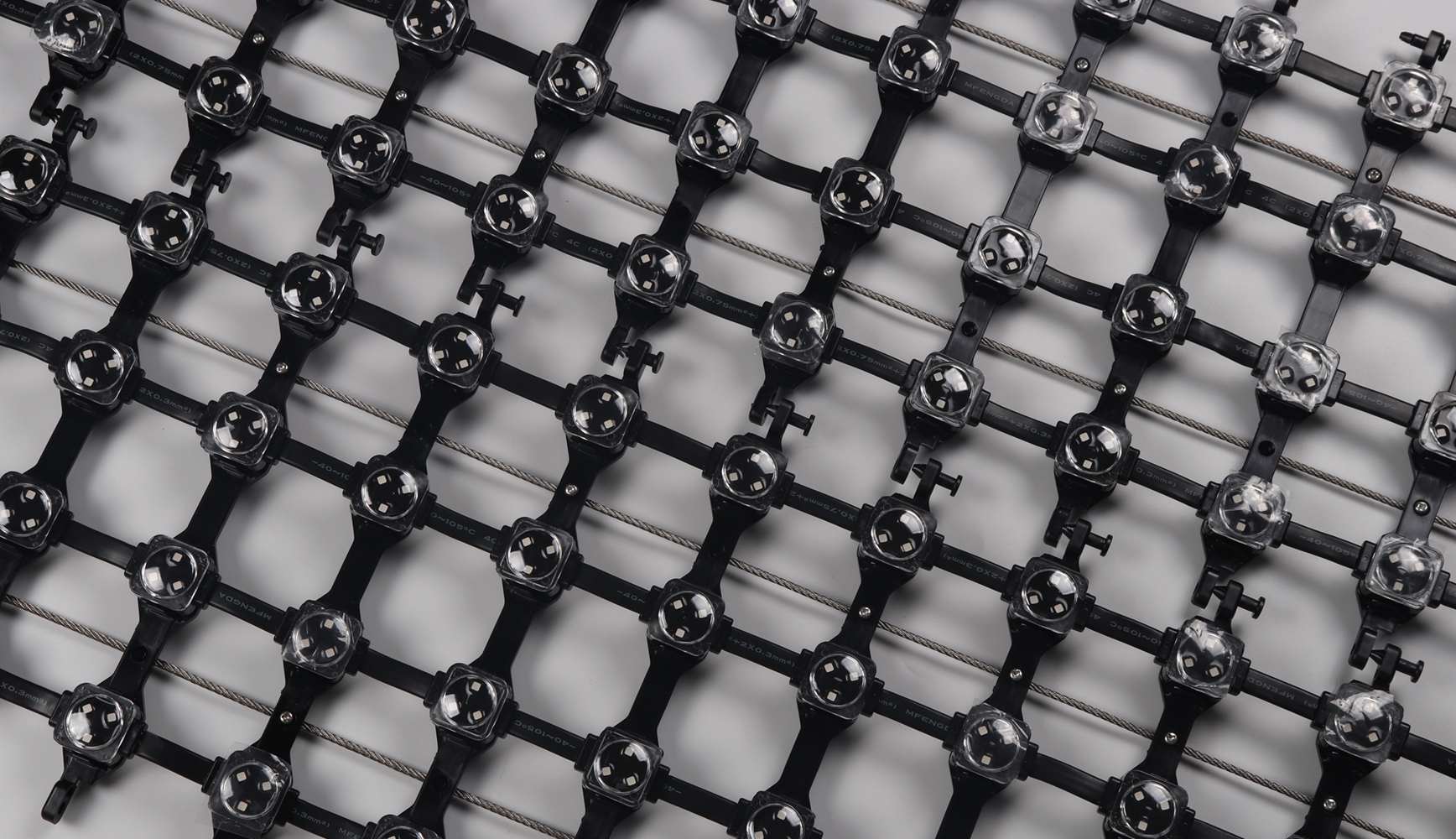
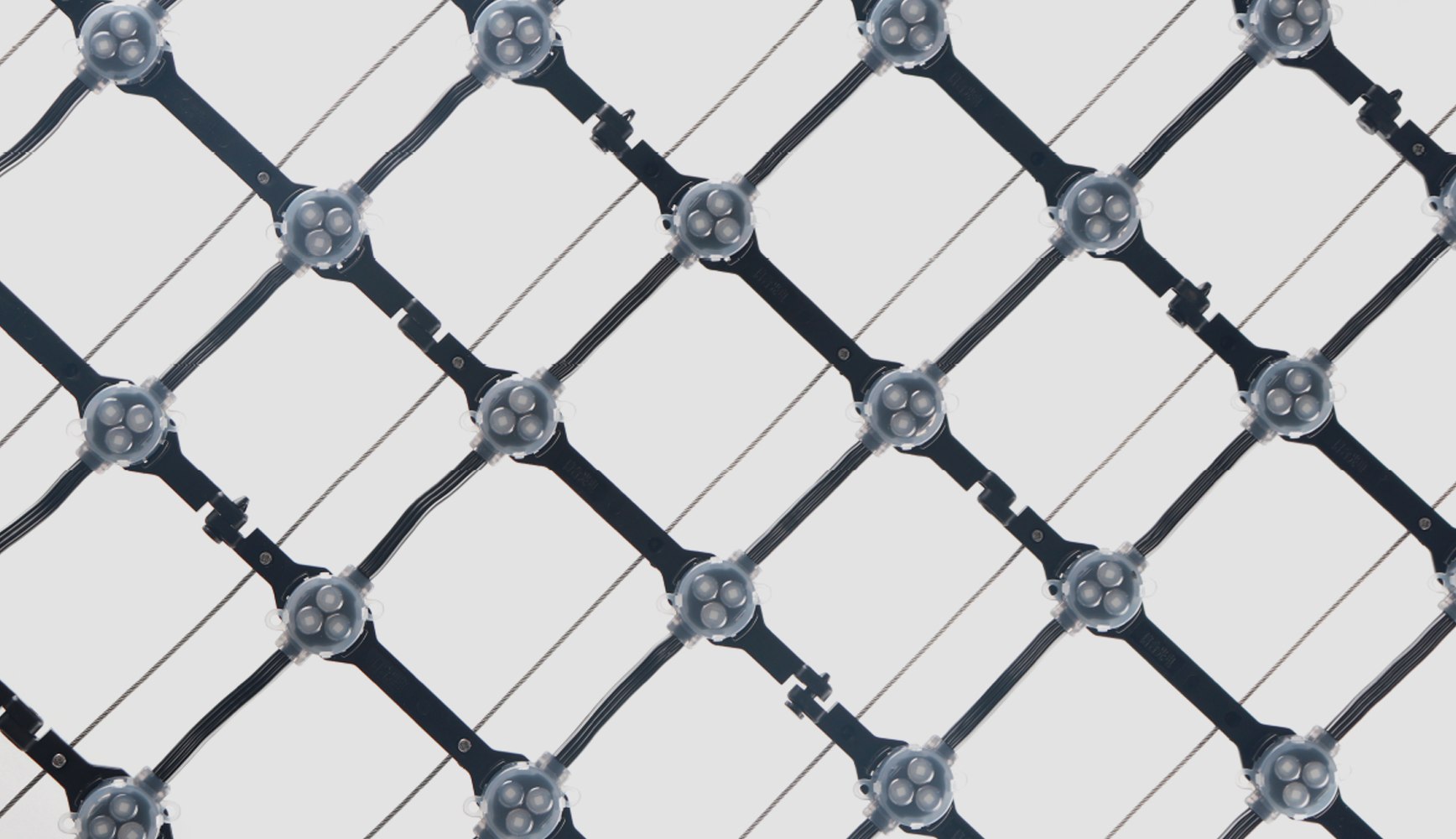
XinHe’s LED mesh and grid screen range includes different voltages and pixel layouts. The G20 and G30 product pages list DC12V configurations, while the L20006 series includes DC15V and DC24V options. Listed maximum power also varies according to the selected configuration, so calculations should always use the final project datasheet.
Maximum Power Versus Average Power
Maximum power represents the highest possible electrical demand. It should be used to size power supplies, distribution equipment, cables, and protection devices.
Average power is more suitable for estimating electricity costs because it changes with screen brightness and displayed content.
Estimated average power = maximum power × expected load factor
When measured operating data is unavailable, use a conservative planning factor and verify the result during system commissioning.
How Do You Calculate Total LED Mesh Screen Power?
Once the display area and product power rating are confirmed, maximum and average demand should be calculated separately. This prevents an undersized electrical system while keeping the operating-cost estimate realistic.
Basic LED Mesh Screen Power Formula
When the datasheet provides a rating in watts per square meter, use the following formulas:
Total maximum power (kW) = screen area × maximum W/m² ÷ 1,000
Average power (kW) = total maximum power × load factor
For example, consider a 100 m² LED mesh screen rated at a maximum of 120 W/m²:
- Maximum power: 100 × 120 ÷ 1,000 = 12 kW
- At a 45% load factor: 12 × 45% = 5.4 kW
Use 12 kW when planning the electrical infrastructure. Use approximately 5.4 kW when preparing a preliminary energy budget.
Why Should Reserve Capacity Be Added?
Power supplies should not be planned around their absolute maximum output. Heat, cable loss, ambient temperature, and operating conditions can reduce their practical capacity.
Required supply capacity = maximum power × reserve factor
Using a 25% planning reserve:
12 kW × 1.25 = 15 kW
The final reserve must follow the power-supply manufacturer’s specifications and the electrical designer’s requirements.
How Many Power Supplies Are Required?
The required quantity depends on total wattage, rated output, operating voltage, derating requirements, and the way the screen is divided into power zones. The calculated result should always be rounded up.
Power Supply Quantity Formula
Use this formula:
Number of power supplies = required capacity ÷ rated output per supply
If a project requires 15,000 W and each power supply provides 600 W:
15,000 ÷ 600 = 25 power supplies
Each power supply must match the LED mesh screen’s specified DC voltage. For a large building façade, it is advisable to divide the display into several power zones. Shorter cable runs help reduce voltage-drop risk, while zoning makes fault detection and maintenance easier.
How Should LED Mesh Screen Cables Be Sized?
Cable selection depends on operating voltage, current, conductor length, installation method, ambient temperature, and applicable electrical regulations. Wattage alone is not enough to determine the correct cable size.
How Do You Calculate Circuit Current?
For a DC circuit, use this formula:
Current (A) = power (W) ÷ voltage (V)
A 120 W load operating at 12V draws 10A. The same 120 W load operating at 24V draws 5A. Low-voltage LED systems can therefore carry substantial current, especially across a large display.
Keep low-voltage cable runs as short as practical. Position power supplies near their assigned screen zones and use multiple feed points where the approved system design permits.
A qualified electrical professional should confirm conductor size, circuit protection, grounding, surge protection, cable routing, and enclosure requirements according to local regulations.
How Is Annual Electricity Cost Calculated?
Annual electricity cost should be based on estimated average power, daily operating hours, annual operating days, and the local electricity rate.
Annual Energy Cost Formula
Use the following calculations:
Annual energy consumption = average power × hours per day × operating days
Annual electricity cost = annual kWh × electricity price per kWh
Using the previous average power estimate of 5.4 kW, with 10 operating hours per day, 365 operating days per year, and an electricity price of $0.15/kWh:
- Annual energy consumption: 5.4 × 10 × 365 = 19,710 kWh
- Annual electricity cost: 19,710 × $0.15 = $2,956.50
Control equipment, network devices, cabinet ventilation, and standby power should also be added when preparing a complete facility operating budget.
How Can LED Mesh Screen Energy Use Be Reduced?
Energy savings should come from suitable product selection and efficient operating control rather than simply choosing the product with the lowest maximum wattage.
Match Pixel Density, Brightness, and Content to the Site
Choose the pixel pitch according to the actual viewing distance instead of automatically selecting the densest configuration. A wider pixel pitch may be sufficient for large façades viewed from a distance.
Brightness schedules can also reduce unnecessary consumption. Use separate settings for daytime, evening, and late-night operation. Content designers should avoid prolonged full-white images when maximum brightness is not required.
XinHe’s LED mesh screen products offer optional densities, modular construction, lightweight structures, transparent heat dissipation, and IP67 protection. They can support installations on solid walls, steel structures, and flat or curved glass façades.
Why Choose Shenzhen XinHe as an LED Mesh Screen Supplier?
A reliable supplier should provide accurate product data and practical support for electrical planning, installation, screen control, and long-term operation.
Reliable Products and Project Support
Established in 2004, Shenzhen XinHe Lighting Optoelectronics Co., Ltd specializes in LED point light sources and grid screens. The company provides services including solution design, engineering budgeting, product supply, and on-site guidance.
Its LED mesh screen portfolio covers multiple pixel pitches, operating voltages, color configurations, and control options for commercial advertising, cultural tourism, glass curtain walls, and large architectural media projects.
Conclusion
An accurate power plan starts with the exact LED mesh screen model, active area, maximum power rating, operating voltage, brightness schedule, and expected media content.
Use maximum demand to size power supplies, cables, and distribution equipment, but use realistic average demand to estimate annual electricity costs. Add suitable reserve capacity, divide large screens into manageable power zones, and have all electrical decisions reviewed according to local requirements.
Early coordination between the LED mesh screen supplier, electrician, structural team, and control-system integrator can prevent voltage problems, overloaded circuits, unexpected energy costs, and expensive installation changes.
FAQs
Does an LED Mesh Screen Always Use Its Maximum Rated Power?
No. Maximum power is mainly used for electrical capacity planning. Actual consumption changes according to brightness, displayed colors, animation, and content. Testing the completed screen under normal operating conditions will provide a more accurate average figure.
Can Power Consumption Be Calculated from Screen Area Alone?
Only when the exact watts-per-square-meter rating is available. Different pixel pitches, LED types, voltages, and color configurations can have significantly different power requirements. Always use data from the selected product configuration.
Can a 24V Power Supply Replace a 12V Power Supply to Reduce Current?
No, unless the LED modules and the complete power system are specifically designed for 24V operation. Using an incorrect voltage can damage the display. Always follow the product specification and the approved electrical plan.





 English
  Arabic
  Russian
  Spanish
  French